2022 I dedicated to studying Ozone therapy at the university of Verona completing the master in Oxygen-ozone therapy in the medical practice: from basic mechanisms to treatment, a.a. 2021-2022 combined with a Stage at Bracciano with my former Osteopathy teacher and Sports Medical Specialist Dr Fabio Fanton.
April 2023 I obtained my master with the thesis “Oxygen-Ozone Therapy in Wikipedia, suggestions for improvement based on scientific research”. I am applying ozone therapy now in my own studios since november 2022 and am very happy because it greatly amplified my possibilities in helping different ailments.
The historic development of Medical Ozone Therapy (ISCO3)
The development of Oxygen-Ozone therapy has been determined by progress of chemical knowledge, development of machines to produce and measure it, biochemical advances and the curiosity of clinicians in the search to find solutions for certain diseases based on the knowledge
of ozone’s (bio)chemical properties.
Once formed, ozone rapidly degrades back to oxygen or reacts with available H, N or other atoms available in its environment.
First its strong oxidative effect was known, explaining its anti-bacterial, fungicidal and anti-viral activity and so at first ozone was applied externally to provide clean drinking water and during the first World War it was applied with success for gangrenous wounds. As a disadvantage, the rubber bags that were used, got oxidized rapidly. This shows us the importance of the development of the right materials to make it applicable.
The discovery of the property of some tumours that thrive under hypoxic circumstances (1926 Warburg) made clinicians curious of its possible anti cancerous effect. Oxygen Ozone therapy in cancer is still controversial. (Bocci, Turska, Zable) But suspicion that it could be mutagenic has been examined and proven not to exist in experiments. (Malatesta, Menéndez-Cepero) Ozone as a chemical molecule, consisting of 3 oxygen atoms, has already been known since 1785. It was first described by the Dutch Physicist Martin van Marum as an odorous gas, as the
odour coming free after lightning, that was formed in the laboratory after an electric spark passed through the air. In 1840 the Swiss University professor, dr .C.F.Schonbein gave it its name because of the strong odour (in Greek Ozein=To smell) and found out about its strong capacity to bind with other molecules in the double bond positions.
Development of the methods of application in humans. From direct application with positive results and mixture with oils, and water for both drinking and direct application, intramuscular injections, intravenous injections and insufflations were being applied and a mixture of autologous blood and ozone and reinfusion of that mixture was invented, the so called O3- autohemotherapy (O3-AHT) (Bocci). The modern refined biochemical research is focused on its mode of action on both the anti-oxidant mechanisms of the cells and nucleus, its role in activating nuclear factors and its modulating role in the inflammatory response. (Viebahn-Haensler,
Malatesta, Galié)
Famous names in the development of ozone generating machines are Werner von Siemens who constructed in 1857 a magnetic induction pipe, producing ozone, used for the purification of drinking water.
In 1896 Nikola Tesla patented a O3 generating system and in 1900 founded the Tesla Ozone Company. In 1957, exactly 100 years after von Siemens, Dr Joachim Haensler
patented his ozone generator that uses a refined photospectrometer to be able to measure and produce a precise mixture with milliliters of pure oxygen and micrograms of ozone from pure medical oxygen. Medical oxygen can easily be produced, distributed and stored in gas cylinders.
Ozone can not be stored so easily, because it quickly decomposes in Oxygen.
The first studies on the biological effects of ozone on animals were done in Russia and published in 1876 by Dr V.V. Chemezov. This knowledge brought dr Razenberg in Crimea to 6 bring his patients out in the open sea immediately after the storm to breath ozone for the treatment of allergies and respiratory diseases.
Since that time important pioneers from universities and clinics from different countries, working together through national and international associations, with critical observation and research, developed the state of the art and knowledge as presented in the following chapters on Mechanism of Action, Therapeutic indications, Techniques of application, Contra indications
and Adverse effects. Pioneers, books and associations are listed in APPENDIX 4
Mechanism of Action
Ozone can be administered either by intramuscular, intra- articular or intra-discal injections, by mixing it with autologous blood and transfusing it back, locally applying it to the skin with bagging and through vaginal or rectal insufflation.
When the ozone reaches the body cells there are two important reaction chains. Ozone will be reacting with the membrane phospholipids and thus produce the following products: Ozonides, Aldehydes, Peroxide, and Hydrogen peroxide. (Viebahn-Haensler)
Secondly these products will act as second messengers activating enzymes like Superoxide Dismutase (SOD) causing an increase in intra erythrocytic 2,3 DPG level, enhancement of general metabolism through improved oxygen delivery and upregulation of a number of antioxidant enzymes as well of haeme oxygenase 1 and Heat Shock Protein 70 (HSP-70).
Ozone’s antioxidant capacity.
Ozone is a potent oxidant. High dosages cause high oxidative stress and eventual inflammation and even damage to the tissue.
Low dosages, though, can activate antioxidant pathways. In other words, low dosage of Ozone activates the homeostasis mechanism in the body to prevent oxidation and damage of cells and structure.
Low concentration Ozone comes in contact with H2O and PUFA
In vitro and in vivo studies of the long-term antioxidant capacity of infiltration with O2-O3 gas mixture in the human body show that it binds immediately to water and cell membrane components like Poly Unsaturated Fatty Acids (PUFA).(Noel L.Smith et al) Hydrogen Peroxide (OH-) and Lipidoxidation products are formed.
After contact with water (H2O), Hydrogen Peroxide is formed and after contact with the PUFA Lipid Ozonation products are formed.
This activates Nuclear Factor Erythroid 2 related Factor 2
The presence of hydrogen peroxide and the lipid ozonation products increase activation of the Nuclear Factor Erythroid 2-related Factor 2 (Nrf2).
Which results in the expression of Antioxidant Response Elements (ARE)
The activation of Nrf2 causes the expression of the so-called Antioxidant Response Elements (ARE) genes. ARE genes are normally associated with Kelch Like Ech Associated Proten-1 (KEAP-1). Now when mildly activated, they dissociate from KEAP-1 and transcription of Antioxidant Response Elements (ARE) driven genes can be induced.7 These genes after being induced will produce antioxidant enzymes as Super Oxide Dismutase (SOD), Glutathione Peroxidase (GPx), Glutathione S-transferase (GST) Catalase (CAT) Heme Oxygenase-1 (HO-1) NADPH HSP-70 that will enhance antioxidant processes. .(Noel L.Smith et al)
The importance of this is that after the immediate oxidative effect, antioxidant mechanisms are stimulated and after repetitive stimulation the antioxidant mechanisms remain active at a higher grade. (Viebahn, Malatesta, Galié)
Vascular and haematological modulation
The presence of O3 causes an increase of efficiency of oxygen delivery to the cells. The mitochondrial respiratory chain is made more efficient.
Secondly low dose ozonised blood enhances blood circulation and oxygen delivery to ischemic tissues as a result of the concerted effect of NO and CO and an increase in intraerythrocytic 2,3diphosphoglycerate (2,3 DPG). (Bocci, How a calculated oxidative stress..)
Pathogen inactivation of bacteria fungi and viruses.
O2-O3 mixture is known in industry for its strong antibacterial, antifungal and antiviral action in disinfecting water, materials, and spaces. In ozone therapy nevertheless this effect is mostly of use in direct application of O2-O3 mixture to
(1) infected wounds, (2) rectal dysbiosis, (3) vaginal dysbiosis, after which the good bacterial flora has to be re-established with micro biotic supplements.
In the blood, in case of a sepsis (microbial infection of the blood) for example, as ozone binds too fast to water, available proteins and PUFA and because of the small dosage used, ozone will not be sufficient to act as an antipathogen. (Bocci)
Immune system activation
In the research of Galie et al, they provide scientific, histologic and biochemical evidence that treatment with a low concentration of ozone in cultured cells promotes nuclear translocation of Nrf2 at the chromatin sites of active transcription and increases the expression of antioxidant response element (ARE) driven genes.
Also, it is now proven that cytokines are directly stimulated by Ozone in fibroblasts and leucocytes.
(Malatesta)
“Nrf2 is able to modulate inflammation through multiple mechanisms, such as the regulation of redox homeostasis and the suppression of pro-inflammatory genes. — Inflammation increases local and systemic ROS level while ROS enhance inflammation. –The Nrf2-KEAP1 mediated ROShomeostatic control can break this vicious cycle.” (Galié et al.)
This is a finding that is falling in place with the publication of Cuadrado in Nature Reviews, where ozone is not yet mentioned. Cuadrado states: “a functional NRF2–KEAP1 axis is essential for protection against a plethora of diseases that have oxidative stress and inflammation as underlying pathological features. “
(Cuadrado)(Lamberto Re)8 Medical Uses Indications And For Each Of Them Mode Of Application And Grade Of Recommendation.
Spine
About 70% of the adult population will suffer one or more periods of neck or backpain in their life. Oxygen-ozone therapy for the spine can be applied by intramuscular injections in the paravertebral muscles of the spine. This gas will encounter muscle cells and will start stimulating the autologous antioxidant and antiinflammatory mechanisms of the cells as described earlier on.
Mechanically it will also create space in an area that has been inflamed and fibrosed for a long time. Squeezed nerves will be liberated and get a better vascularisation and thus can start to repair their myelin sheet and will be able to conduct their information again.
It can’t be emphasised enough that combination of physical therapy and exercise, will be complementary and help to get a positive outcome and prevent recurrent events because of bad posture and wrong use of the spine.
Intradiscal injection under CT guidance or fluoroscopy will create discolysis and therefore the intervertebral disc material will be reabsorbed faster than naturally would occur and will decompress the nerve in order that symptoms of pain, muscle weakness or numbness can recede.
Nerve Entrapment Syndromes
The antioxidant, anti-inflammatory and mechanical effect of an injection of low dose oxygenozone according to appropriate protocols, will decrease pressure on the nerve, diminish edema, dilate fibrosed tissue, will improve the vascularisation of the nerve sheet and thus enable the nerve to conduct electrical impulses and function better.
Arthrosis And Synovitis
Intra-articular infiltration of Oxygen Ozone is effective for arthritis and synovitis, (Raeissadat) will cause an anti inflammatory and antioxidant reaction with the cartilage and capsule of the joint.
When moving and mobilizing the joint directly after the infiltration a bubbling-squeezy sound will be heard of the gas/liquid mixture being moved around in the joint.
Various Generalized Degenerative Diseases
It will be worthwhile to continue clinical researh on the effect of ozone on many of the named
diseases in Table 2.
The best proof is there for are Diabetic Foot Ulcers (Wainstein et al.) , Dry Maculopathy (Bocci) with
Grade of Evidence A.
The others have promising results in smaller types of studies which were based on the mechanism of action that could be of benefit for the pathology and for now are in the table with Grade of Evidence C.
I had a patient with a positive outcome for Dupuytren disease with contractures of 90°of the IInd and IIIrd finger of the left hand. After 7 sessions of subcutaneous and peritendinous infiltration with O3 and intra-articular infiltration with O3 of the PIP, DIP and MTP joints of the fingers, she had a complete retrieval of the hand function, no scars and no retraction. I followed the protocol from the book by Zambello and Bonetti. Although the Grade of Evidence is classified as “C” for these pathologies, the result in this case was very good and it meant a great difference for the
patient who was able to write again after the treatment. This and so many other cases show how continuous research for evidence in Ozone Therapy may benefit more and more patients.9
Therapeutic Indications
The following table 1 shows the therapeutic indications for ozone therapy.
The grade of evidence according to the standard of Evidence Based Medicine (EBM) are
A= Shown statistically relevant evidence in Systematic Reviews (SR) of Randomised Controlled Trials (RCT).
B =Systemic Reviews of Case Control (Individual or Cohort) studies.
C = Expert opinion without explicit critical appraisal or based on physiology bench research. (OCEBM)
TABLE 1 THERAPEUTIC INDICATIONS (Burns, Smith 2017, Linee Guida e Buone Pratiche in Ossigeno Ozono terapia art. 6-L. 8 marzo 2017
n.24, Zambello, Bonetti et al)
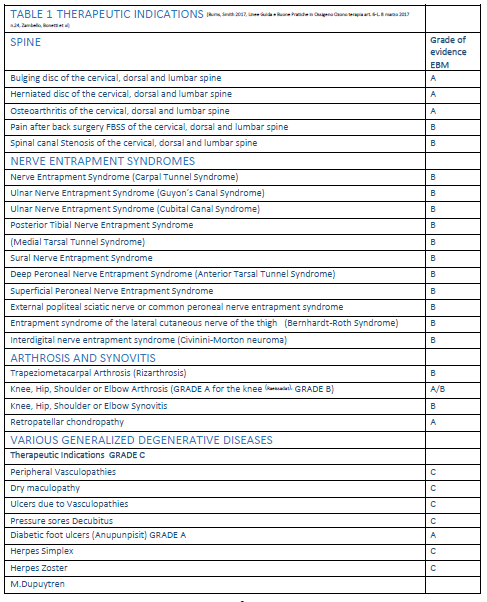
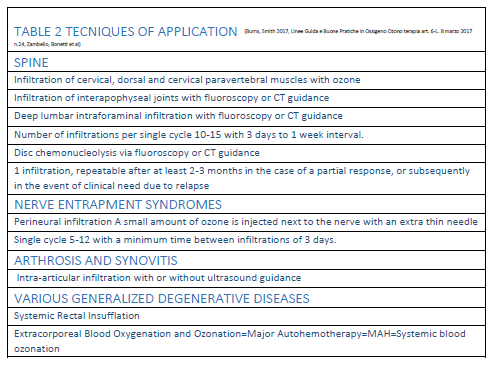
TABLE 2 TECNIQUES OF APPLICATION (Burns, Smith 2017, Linee Guida e Buone Pratiche in Ossigeno Ozono terapia art. 6-L. 8 marzo 2017
n.24, Zambello, Bonetti et al)
SPINE
Infiltration of cervical, dorsal and cervical paravertebral muscles with ozone
Infiltration of interapophyseal joints with fluoroscopy or CT guidance
Deep lumbar intraforaminal infiltration with fluoroscopy or CT guidance
Number of infiltrations per single cycle 10-15 with 3 days to 1 week interval.
Disc chemonucleolysis via fluoroscopy or CT guidance
1 infiltration, repeatable after at least 2-3 months in the case of a partial response, or subsequently
in the event of clinical need due to relapse
NERVE ENTRAPMENT SYNDROMES
Perineural infiltration A small amount of ozone is injected next to the nerve with an extra thin needle
Single cycle 5-12 with a minimum time between infiltrations of 3 days.
ARTHROSIS AND SYNOVITIS
Intra-articular infiltration with or without ultrasound guidance
VARIOUS GENERALIZED DEGENERATIVE DISEASES
Systemic Rectal Insufflation
Extracorporeal Blood Oxygenation and Ozonation=Major Autohemotherapy=MAH=Systemic blood
ozonation
11
Contraindications
Systemic ozone or auto-haemotherapy is contraindicated in glucose-6-phosphate
dehydrogenase (G6PD) deficiency so-called “favism.” for the greater susceptibility of the red cells to oxidative stress.
It is not recommended during pregnancy and competitive sports. This is despite the fact that there are no scientific studies contra-indicating its use (on the contrary, positive experiences of oxygen ozone therapy are reported for the treatment of some pregnancy-related diseases and in sports performance for the beneficial antioxidant effect) The use of ozone therapy may be discouraged from a medical-legal point of view to avoid litigation today with a doubtful outcome. Hypotensive episodes have been reported in patients on Angiotensin-converting enzyme (ACE) inhibitor therapy and it is not recommended to take ACE inhibitors on the day of systemic therapy;
Patients on dicumarol therapy will need to carefully monitor their INR;
Patients with a positive history of epilepsy may experience a seizure in conjunction with the administration of therapy.
The use of systemic ozone therapy without medical grounds or while preparing for sporting competitions constitutes doping.
One of the contraindications is symptomatic Pervious Foramen Ovale which occurs in a fraction of the people with asymptomatic PFO (20-25% of the normal adult population). Careful search during auscultation of a possible diastolic murmer gives an indication of seriousness of PFO. If a murmur is present ozone should be avoided to be administered via a systemic route (Autohemo infusion) to avoid a gas embolus.
Adverse Effects
Adverse effects are those related to the puncture (hematoma at the site of injection) or vagal reactions (sweating, bradycardia, hypotension with alterations in cardiac rhythm up to decompensation), equal to those associated with any infiltrative therapy and do not depend on he oxygen-ozone mixture.
Vagal seizures, which are usually transient, resolve spontaneously within a few minutes; otherwise, the usual medical treatment must be applied.
Gas embolism can occur if the needle for intramuscular injection or intradiscal has been inserted in a vein or artery. All medical doctors and nurses are trained to withdraw the plunger of the syringe 12 D